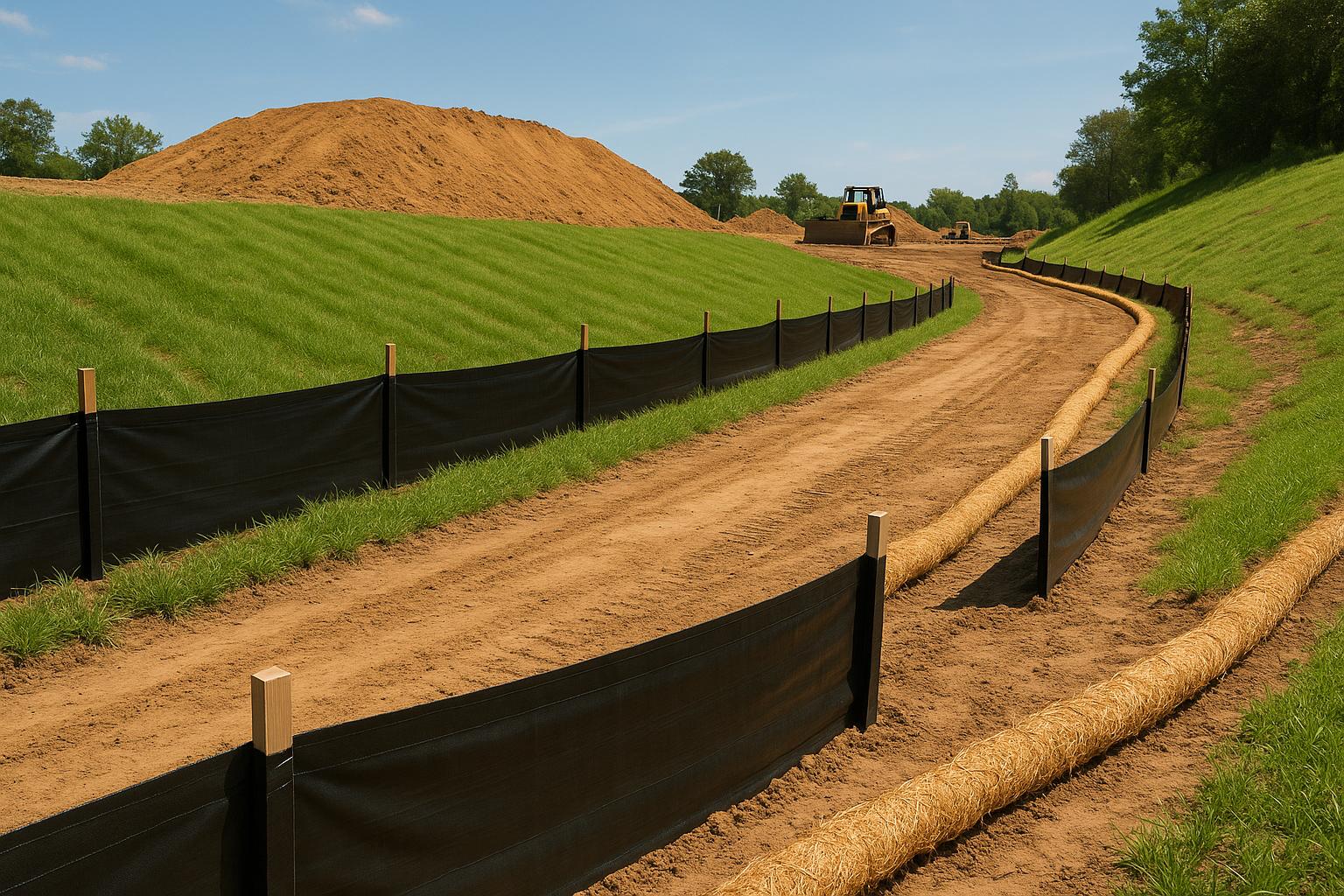
If your project in Puerto Rico moves dirt, whether that is clearing, grading, excavation, or fill, you need a Plan CES before the first machine starts. Public or private, it makes no difference. Skip it and you risk permit delays, fines, or a stop-work order.
Here is what the document is, who has to have one, and what goes in it.
What Is a Plan CES?
A Plan CES (Plan de Control de Erosión y Sedimentación) is an engineering document written for one specific site. It describes how the project will keep soil in place and keep sediment from washing off the property, during construction and after. In Puerto Rico it is the main tool for managing runoff from disturbed ground.
The plan lists the controls, known as Best Management Practices (BMPs), and says when each one goes in, how it is maintained, and when it comes out. Silt fences, sediment basins, rock check dams, inlet protection, stabilized entrances: that kind of thing.
Key distinction: A Plan CES covers erosion and sediment only. A SWPPP (Stormwater Pollution Prevention Plan) is a separate federal NPDES document covering a wider list of pollutants. The two overlap, and many projects need both.
Who Is Required to Have a Plan CES?
A Plan CES is required for any project that disturbs the natural soil surface in Puerto Rico, including:
- Residential and commercial land development
- Road construction and infrastructure projects
- Site grading and earthwork operations
- Quarry and mining operations
- Municipal and government construction projects
- Any project requiring a construction and use permit from OGPE (Oficina de Gerencia de Permisos)
The exact threshold depends on the disturbed area and on the permit you are applying for. The practical rule is simpler: if you are moving soil in Puerto Rico, assume you need one.
Puerto Rico's Regulatory Framework
Three agencies have a hand in this, and their requirements overlap:
DRNA: Departamento de Recursos Naturales y Ambientales
DRNA is the island's environmental agency. Under Regulation No. 9013 (Reglamento de Estándares y Procedimientos Ambientales) it requires erosion and sediment controls on any project that touches natural terrain or a watercourse. The Plan CES is the document you file to show you have them.
OGPE: Oficina de Gerencia de Permisos
OGPE issues construction and use permits. If the project disturbs earth, OGPE wants the Plan CES in the application package before it will process the permit.
EPA Region 2: NPDES Construction General Permit
Disturb one acre or more and the federal NPDES Construction General Permit applies, administered by EPA Region 2. That permit asks for a SWPPP, and much of the BMP work in a Plan CES carries over. When a project needs both, we write them together so the drawings and BMP lists agree with each other.
What Must a Plan CES Include?
A Plan CES that will pass review needs all of this:
- Site description: Project location, total area, area of disturbance, soil type, drainage patterns, and proximity to waterbodies or sensitive receptors
- Existing and proposed topography: Grading plans showing drainage flow directions and slopes
- BMP schedule and locations: Detailed drawings showing where each erosion and sediment control measure will be installed at each phase of construction
- BMP specifications: Design dimensions, materials, and installation instructions for each control measure
- Construction phasing: A schedule showing when BMPs are installed, modified, and removed relative to construction activities
- Inspection and maintenance program: Frequency of site inspections, documentation requirements, and maintenance procedures for each BMP
- Responsible party information: The owner, contractor, and licensed engineer of record
- PE seal: The Plan CES must be prepared and sealed by a licensed Professional Engineer (PE) registered in Puerto Rico
Inspection and Maintenance Requirements
A plan on file is only paper. The BMPs have to be in the ground before you disturb anything, kept up through the job, and inspected on a schedule, with dated field reports to prove it. When a control fails or the site changes, you fix the control and update the plan.
Inspections are typically triggered by:
- A defined regular schedule (typically weekly during active construction)
- After any significant rainfall event
- After major construction activities that alter drainage patterns
Consequences of Non-Compliance
Working without a valid Plan CES, or with one you are not following, can bring:
- Stop-work orders from DRNA or OGPE
- Monetary fines and penalties under Puerto Rico environmental statutes
- Permit revocation or suspension
- Liability for downstream sediment damage to wetlands, streams, or adjacent properties
- Federal enforcement action from EPA Region 2 for NPDES violations
In our experience, enforcement rarely comes from bad intent. It comes from projects that broke ground before the plan was finished, or from plans nobody updated when the site changed. Either way, compliance costs less than the alternative.
How Often Does a Plan CES Need to Be Updated?
Treat it as a living document. Amend it when:
- The project scope or footprint changes significantly
- Site drainage patterns are altered by construction activities
- A BMP fails and a different control measure is substituted
- New phases of construction begin that were not addressed in the original plan
Need a Plan CES for Your Project?
TerraTek prepares Plan CES documents for projects across Puerto Rico, sealed by a licensed PE and coordinated with your DRNA, OGPE, and NPDES requirements.